
epth Security Home
Penetration Testing
Industries
Case Studies
Company
Resources
Contact Us
In the Eye of the Cyber Storm: Shielding Financial Institutions from Online Threats

When organizations review the results of a vulnerability assessment or penetration test, the findings that command the most attention are usually those labeled Critical or High. These findings receive immediate attention, dedicated resources, and expedited remediation because the risk is obvious, while lower-severity findings rarely receive the same urgency.
Issues like a missing security header, an exposed configuration file, an outdated JavaScript library, an overly permissive service account, or a forgotten development endpoint often end up at the bottom of the remediation list and appear to have little to no immediate impact. Unfortunately, attackers don’t agree.
Modern cyberattacks involve attackers seeking opportunities to combine multiple small weaknesses into a complete attack path. Individually, each finding may seem harmless. These seemingly harmless findings can provide everything an attacker needs to compromise an environment.
This concept is known as vulnerability chaining, and it’s one of the primary reasons human-led penetration testing continues to provide value that automated vulnerability scanning cannot.
Security teams rely on severity ratings to prioritize remediation efforts. This is an effective way to manage large numbers of findings.
A low-severity issue in an isolated environment may remain low risk indefinitely. The same issue inside a modern cloud environment can become something entirely different. Today’s organizations operate highly connected infrastructures where applications, APIs, cloud storage, identity providers, automation platforms, CI/CD pipelines, third-party integrations, and internal services all rely on one another.
These trusted relationships allow businesses to operate efficiently, but they also create opportunities for attackers.
Rather than searching for a single point of failure, attackers look for a sequence of opportunities. A typical attack may resemble something like this:
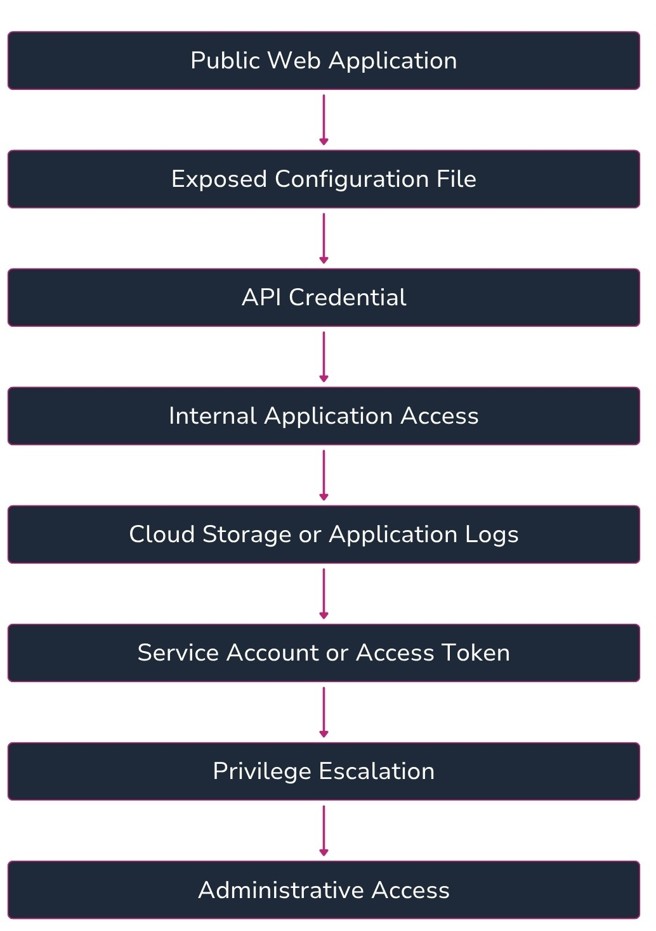
The significance of this approach is that the initial vulnerability does not necessarily need to provide immediate access to sensitive systems. Instead, it may provide the information, permissions, or visibility needed to identify the next step in an attack.
This is why vulnerability management cannot rely solely on individual severity ratings. A finding that appears low risk on its own may become far more impactful when combined with other weaknesses across an interconnected environment.
While every environment is different, certain findings frequently appear during penetration tests and can become valuable components of a larger attack chain.
Finding:
Exposed configuration files
Why It Matters:
May reveal credentials or internal architecture
Finding:
Hardcoded API keys
Why It Matters:
Can provide access to internal services
Finding:
Verbose error messages
Why It Matters:
Leak infrastructure information
Finding:
Directory listings
Why It Matters:
Expose sensitive files
Finding:
Backup files
Why It Matters:
Often contain credentials or configurations
Finding:
Excessive permissions
Why It Matters:
Expand attacker capabilities
Finding:
Misconfigured cloud storage
Why It Matters:
Exposes sensitive data
Finding:
Public development environments
Why It Matters:
Frequently have weaker controls
Finding:
Outdated third-party libraries
Why It Matters:
Can become exploitable after initial access
The presence of these findings does not automatically indicate a security breach, and their risk depends on how they interact with the surrounding environment and whether an attacker can use them to progress toward a larger objective.
An organization that accidentally exposes an application configuration file during a routine deployment. The file contains an old API credential that developers assumed was no longer in use. A vulnerability scanner correctly identifies the exposed credential, but because the credential has limited permissions, the issue is assigned a low severity rating and scheduled for remediation during the next maintenance cycle.
An attacker approaches the situation differently. Instead of stopping at the credential itself, they use it to access an internal application. While exploring the application, they discover application logs containing additional service account information. Those accounts provide access to an automation platform responsible for deploying software updates throughout the environment.
The automation platform stores deployment secrets that grant access to cloud resources. From there, excessive permissions allow the attacker to retrieve additional credentials, move laterally between systems, and ultimately obtain administrative access.
At no point did the attacker exploit a single critical vulnerability, and the compromise resulted from several seemingly minor issues working together. This is exactly why focusing exclusively on severity ratings can create a false sense of security.
Automated vulnerability scanners are an essential part of every security program because they quickly identify known vulnerabilities, outdated software, missing patches, insecure configurations, and thousands of other common issues across large environments.
What they cannot do is think like an attacker. Human testers ask questions that automated tools simply cannot answer:
These questions require context, creativity, and experience. Real attackers continue exploring until they understand how systems interact, where trust exists, and how small weaknesses can be combined to reach high-value assets. Effective penetration testing follows that same mindset.
Modern enterprise environments have become increasingly interconnected:
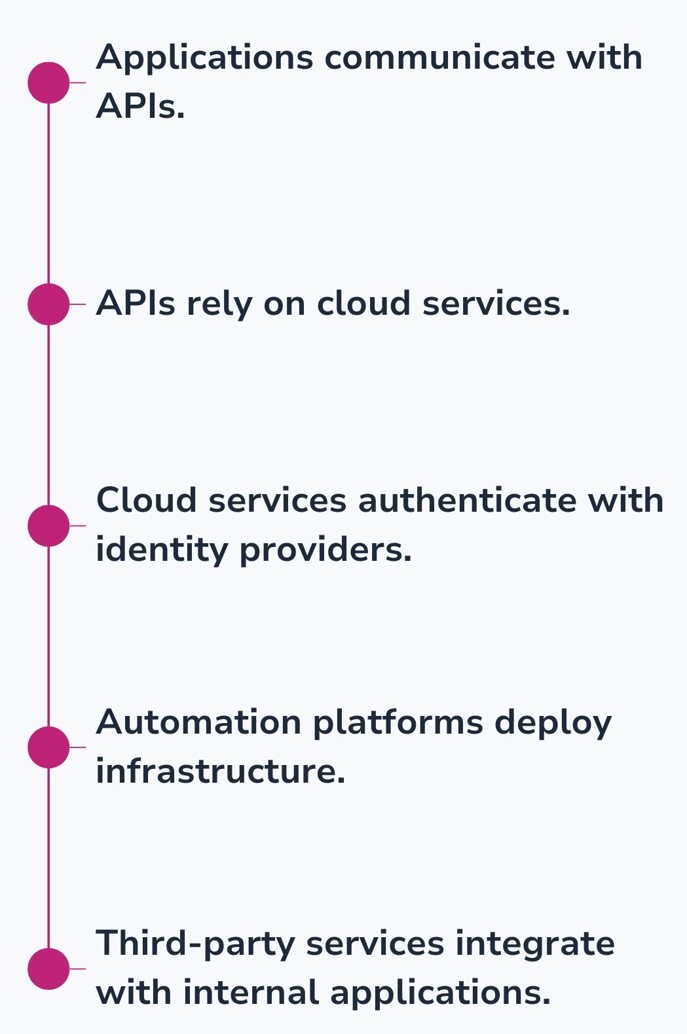
Every connection creates another trusted relationship. The more connected these systems become, the more opportunities attackers have to move laterally once they establish an initial foothold.
It is important to note that this doesn’t mean cloud platforms or automation technologies are inherently insecure. It just means organizations must evaluate security from the perspective of the entire environment rather than individual systems operating in isolation.
The consequences of vulnerability chaining extend well beyond technical compromise. An attacker who successfully moves through an environment may gain access to sensitive customer information, intellectual property, financial records, authentication systems, or production infrastructure. The resulting impact can include:
In many cases, organizations are surprised to learn that an advanced zero-day exploit didn’t cause the breach. Instead, it began with a series of overlooked findings that appeared insignificant during earlier security reviews.
Automated vulnerability scanning remains one of the most valuable defensive technologies available today, but it represents only part of a mature security program.
Understanding how an attacker might combine multiple findings requires human analysis. With experienced penetration testing, you can evaluate attack paths, trust relationships, opportunities for privilege escalation, and how seemingly unrelated weaknesses interact across an environment.
Identifying those attack paths before an attacker does is one of the greatest advantages of comprehensive penetration testing, and one of the most effective ways organizations can reduce real-world risk before it becomes a security incident.
Attackers don’t evaluate vulnerabilities one at a time, and security assessments shouldn’t either. Looking beyond individual findings to understand how they interact provides a more accurate view of organizational risk and a stronger foundation for remediation.